Our design system did what design systems are built to do. It gave us consistent, reusable components, documented for humans who assemble them with judgment.
Then the people building our product changed. Our company moved to an AI-assisted delivery lifecycle, and product managers started building prototypes directly with AI coding tools. Engineers were generating interface with AI too. Before long, nearly everyone was a builder, and most of them weren't designers.
The early results showed the gap quickly. The AI had our components but not our expertise. It used our atomic components correctly, but it didn't know how to put them together into a product we would actually release. That's the part designers carry in their heads, and it showed most when non-designers were using the tools, because there was no designer in the loop to fill it in.
The problem as we first framed it was simple: keep AI-generated interface consistent with the design system.
Why it was the wrong problem
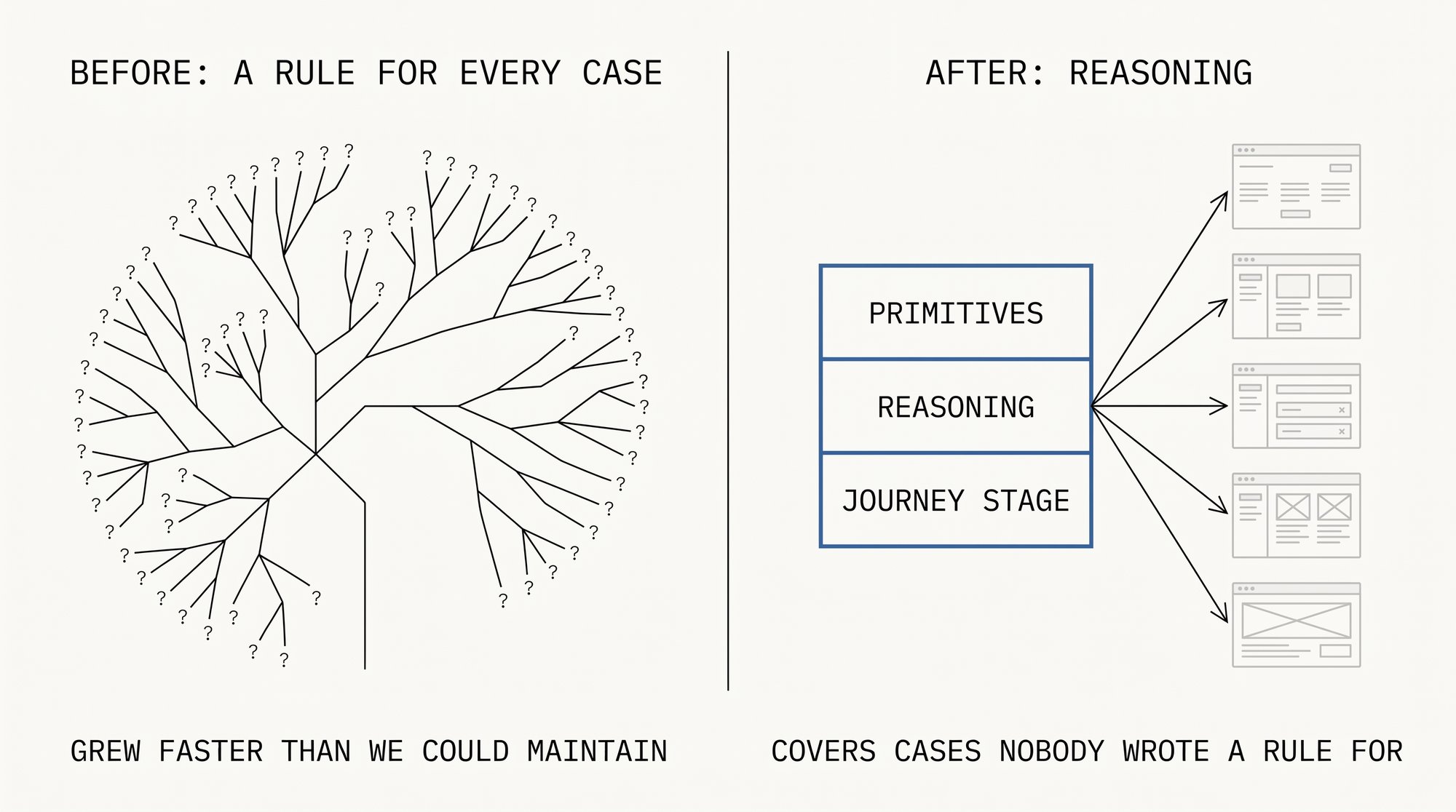
Our first attempt went straight at that problem. We tried to build a large decision tree for the AI to follow, covering pattern usage and how our atomic components work with each other. If this situation, use that pattern. If these two components meet, do this.
It grew exponentially. Every new pattern multiplied the branches, and the tree still couldn't cover a case nobody had thought of yet. We abandoned it.
That failure taught us something more useful than a working tree would have. Traditional design systems optimize for consistency, and consistency is close to impossible when everyone is building with non-deterministic tools. You can't write enough rules to pin down a system that improvises by nature. Chasing that would have meant a design team permanently writing rules and permanently losing.
The real problem
So I asked the team a question: what if we threw out the design system entirely and just described how we design? What's the smallest set of primitives and the clearest philosophy that would make something feel like our product?
It was never the plan, and the reactions told us a lot. Engineers pushed back hard, because they'd lose code consistency, accessibility and shared implementation. Designers had a lightbulb moment, because what they actually cared about protecting was their expertise, not the component library.
Both were right, and that became the answer. The real problem wasn't consistency. It was judgment: teaching the AI to think like a designer. So we kept the design system and added a layer on top of it.
How it works
Decision: layer intent on top, don't replace
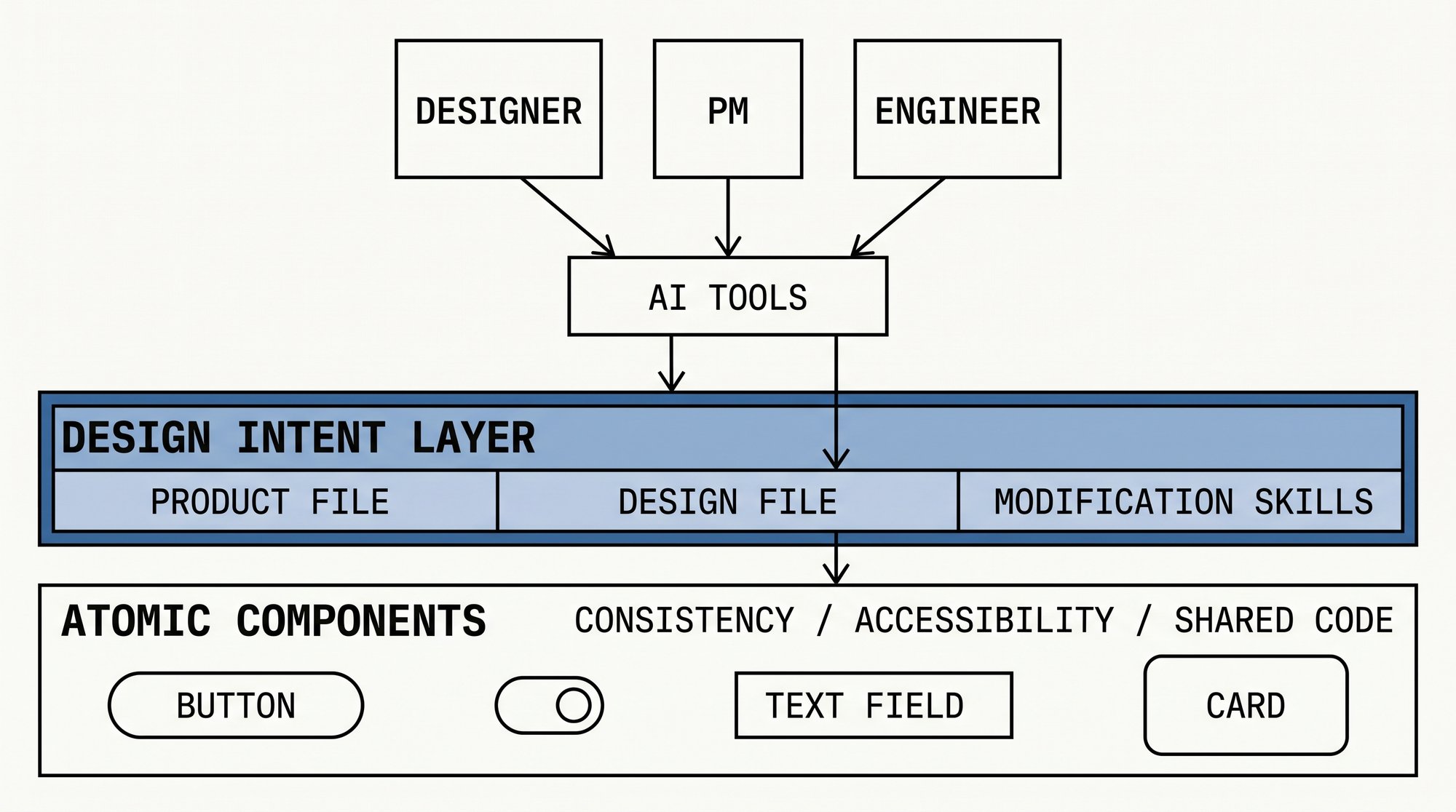
The design system stays the foundation. Atomic components still give engineers code consistency, accessibility and a shared implementation. On top sits a design intent layer, written in plain markdown that AI tools load as context:
A product file: who we serve and the conditions they show up in.
A design file: our primitives (typography, color, spacing, motion, interaction, content) and the reasoning behind each choice.
Modification skills: vocabulary for adjusting tone, delight and seriousness within guardrails.
The intent layer teaches the AI three things a component library can't: how atomic elements combine, which design templates fit which situations, and where the person is in their journey, so it knows what kind of experience to design.
Some rules never bend. Others are strong defaults the AI can override if it names a reason. Primitives are firm opinions. Modification skills are where the AI makes situational calls. As I've come to put it, AI works better through collaboration than control.
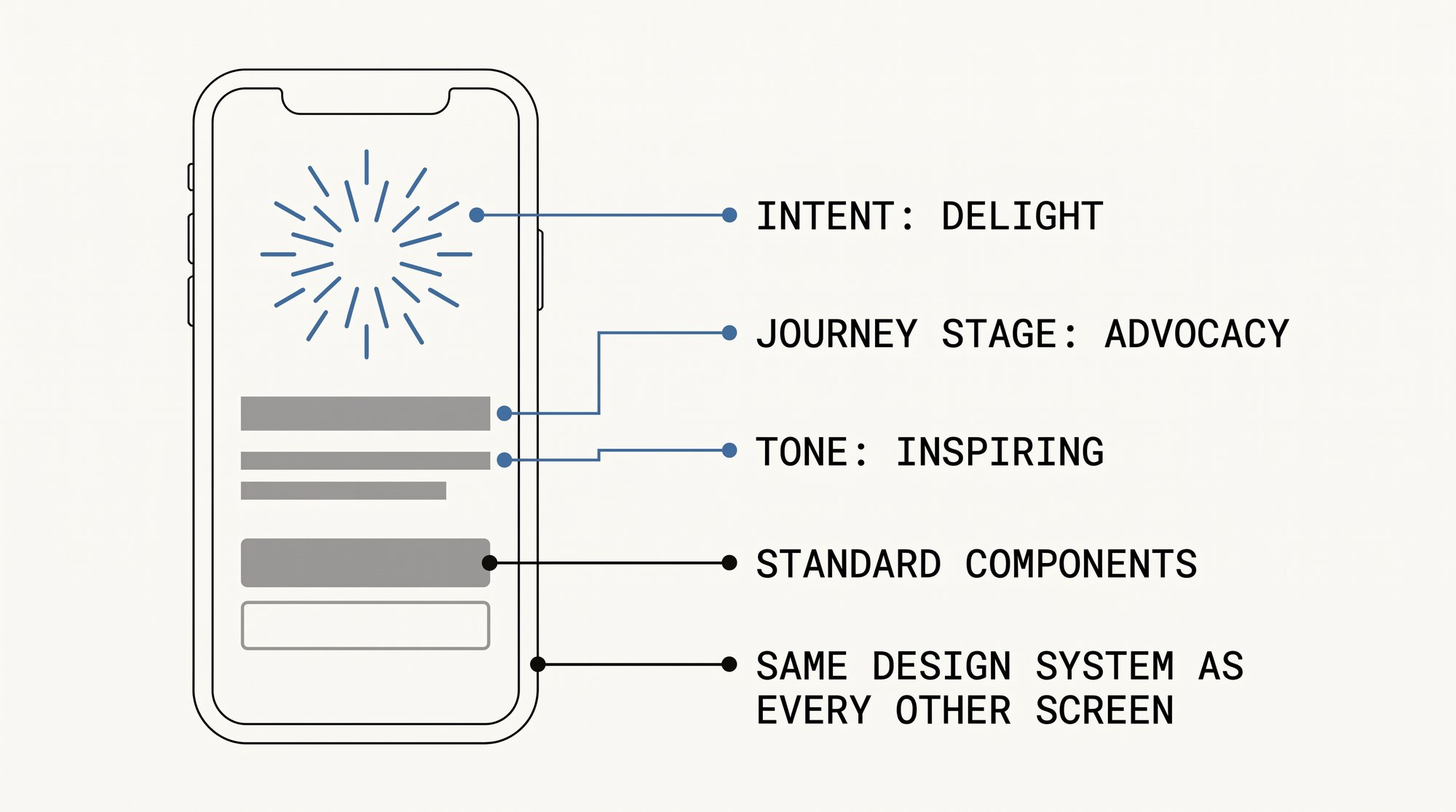
A sharing moment is a good example. When someone has just given and wants to tell people about it, they're at the advocacy stage of the journey. The intent layer tells the AI that this moment should be inspiring and delightful, so it builds something worth sharing, using the same components it would use anywhere else.
The cost: we gave up the idea of a pixel-perfect, predictable system. Output varies, by design. That's an uncomfortable trade for anyone who grew up on design systems, me included, and it means review never goes away.
Decision: fold it back, with the whole team
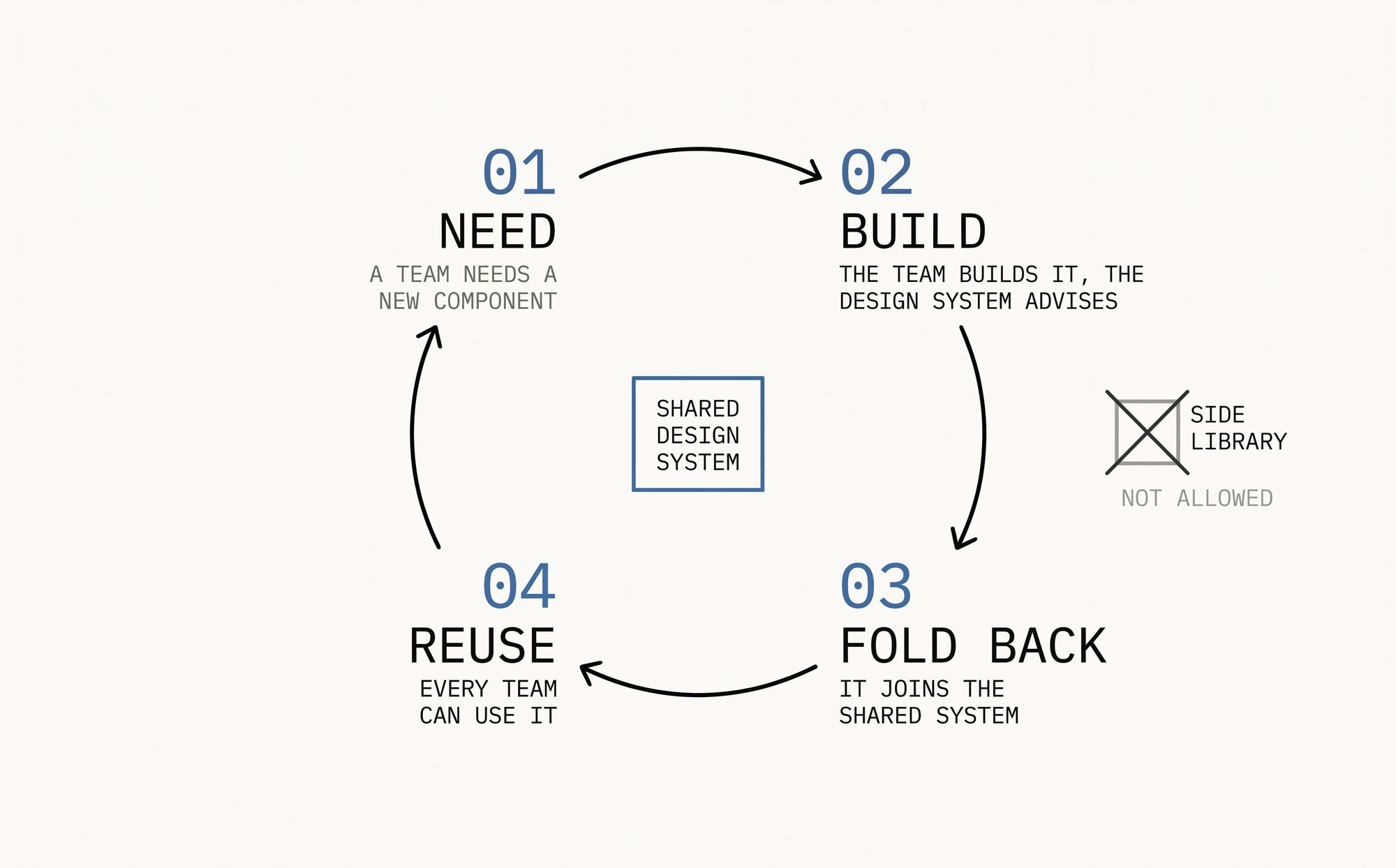
We don't have a dedicated design system engineering team, so we had to decide how new components get made. The model we agreed with engineering: the team that needs a component builds it, the design system advises, and every component has to fold back into the system. No side libraries.
The cost: the model depends on discipline. When teams didn't establish the reuse case up front, some components ended up outside the system and had to be revisited. We learned that reuse starts with what product managers bring when they ask for a component, not only with the design system.
Bringing people along
It started as a side project. Our senior designer and a couple of engineers kicked this off with me as a side-of-the-desk proof of concept. It grew into how we design, and the design system plugin they built now holds more than 300 skills.
Engineering as partners. The thought experiment only worked because engineers pushed back. Their concern about code consistency is why the intent layer sits on top of the design system instead of replacing it. In parallel, platform engineering is consolidating several older versions of our design system in legacy code into one, so the whole product can move onto the current system.
Co-authored. I wrote the plan for the intent layer with our senior designer, who has done more to build it than anyone. She also built the audit skill described below.
Built in the open. Designers and content designers change the system through pull requests, the same way engineers do, so the people with design judgment are the ones maintaining it.
What changed
We're in a beta phase. The system is in use and still evolving:
Product managers are starting to build with it, prototyping directly with AI tools that read our components and our intent.
It's an input to our AI-assisted delivery lifecycle, so design intent reaches work from the start rather than being checked at the end.
AI-generated pull requests are more consistent. Our senior designer's audit skill turns a set of user flows into a clear plan of which existing components to use and what's genuinely new. It's been used in a number of sessions, and the code coming out of AI tools has become more consistent as a result.
The skills keep improving because designers correct them. Every time a designer reviews the audit skill's output and finds something it missed, the skill gets refined. That correction loop is the part of the job that doesn't get automated.
The whole team contributes. We're moving the design system to a more distributed model where every designer contributes, instead of resting on one person.
Reflection
If I did it again, I'd lead with the thought experiment instead of starting by adapting the old system. The decision tree was me trying to make the AI predictable before I'd taught it judgment. Rules scale badly. Reasoning scales. We'd have reached the intent layer sooner if I'd started by asking what we were actually protecting.