Our company had design tenets before. An earlier set, from previous design leadership (I helped draft them), was thoughtful and well written, and it went almost nowhere. They only lived in the product design world. Product managers didn't use them, leadership didn't reference them, and nothing in how we built products checked against them. They had no teeth.
By 2026 the stakes were higher. We'd moved to an AI-assisted delivery lifecycle where product managers prototype directly, often with AI tools, so a design standard now had to govern people who aren't designers. As I put it to leadership, whether it's a designer doing a flow or a PM building a prototype, we all need to be working from the same standard of what good looks like.
So the problem wasn't writing better tenets. Tenets without buy-in are useless, and the best way to get buy-in is co-creation. My design team had the expertise and the opinions. Product leadership had the vision and the authority. My job was to sit between the two and turn the strengths of both into something with staying power that could actually be enforced.
Bringing the team's work to leadership
The substance started with my team. In their own workshop, our designers and content designers identified five real tensions in how we make product decisions, and wrote them out at length. That work was the foundation, and I made sure leadership knew it.
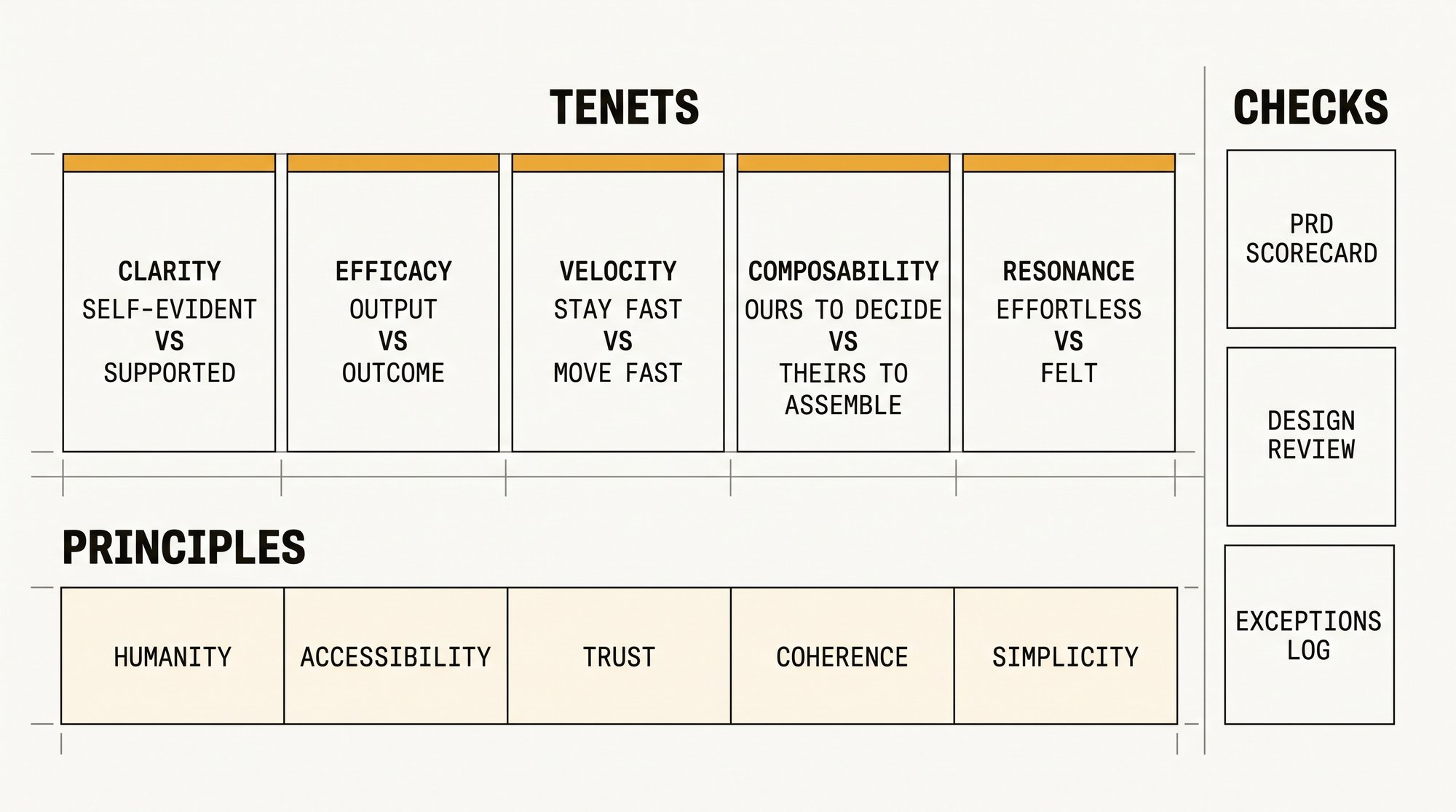
I turned it into a framework sized for a leadership audience:
Principles are givens nobody argues with: Humanity, Accessibility, Trust, Coherence and Simplicity.
Tenets take a side in a real tradeoff: Clarity, Efficacy, Velocity, Composability and Resonance.
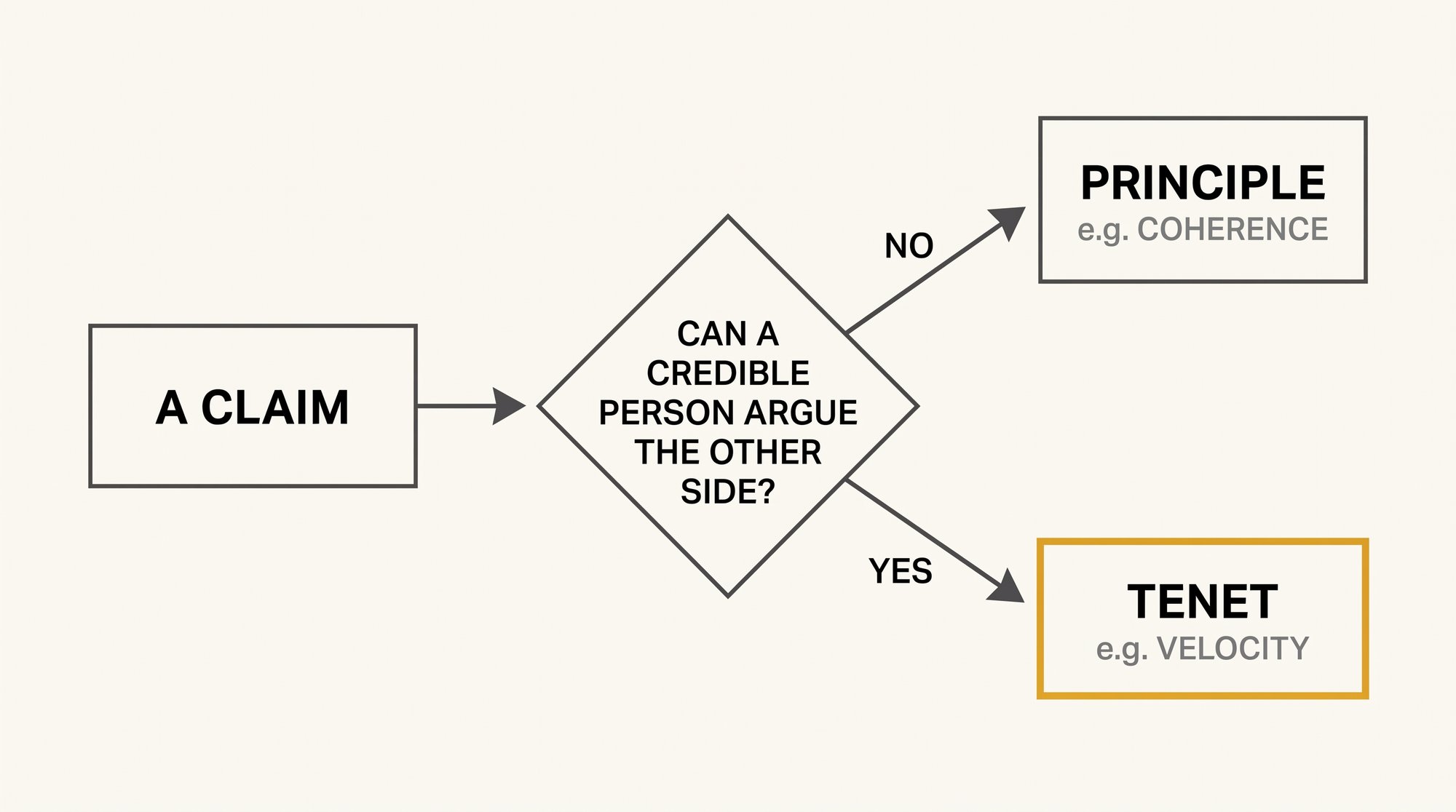
The sorting test decides which is which: can a credible person argue the other side? If not, it's a principle. If so, it's a tenet, and part of the craft is finding the real opponent, never a strawman.
Decision: teeth from checks, not sponsors
The obvious way to give tenets weight is to name an executive sponsor for each one. I didn't, because our organization is matrixed: the tenets run across every product area, while VP ownership runs down through each one. A sponsor per tenet maps to nothing.
Instead, the teeth come from the places decisions already get made: a PRD quality scorecard, design and prototype review, and an exceptions log where a deliberately broken tenet gets its reason written down. A broken tenet with a documented reason isn't a failure. It's the tenet doing its job.
The cost: checks take longer to build than naming a sponsor takes to announce. Those checks are still being formalized, so for now design does the enforcing.
The room
I designed a single workshop with about 13 product leaders, including our CPO, to cover all five tenets in one session.
Decision: draw it out of leadership, don't present it
The easy version would have been a polished presentation and a request for approval. I went the other way and told the room plainly that the design team had already done the deep work, and that their job was to make the calls, harden them and try to break them.
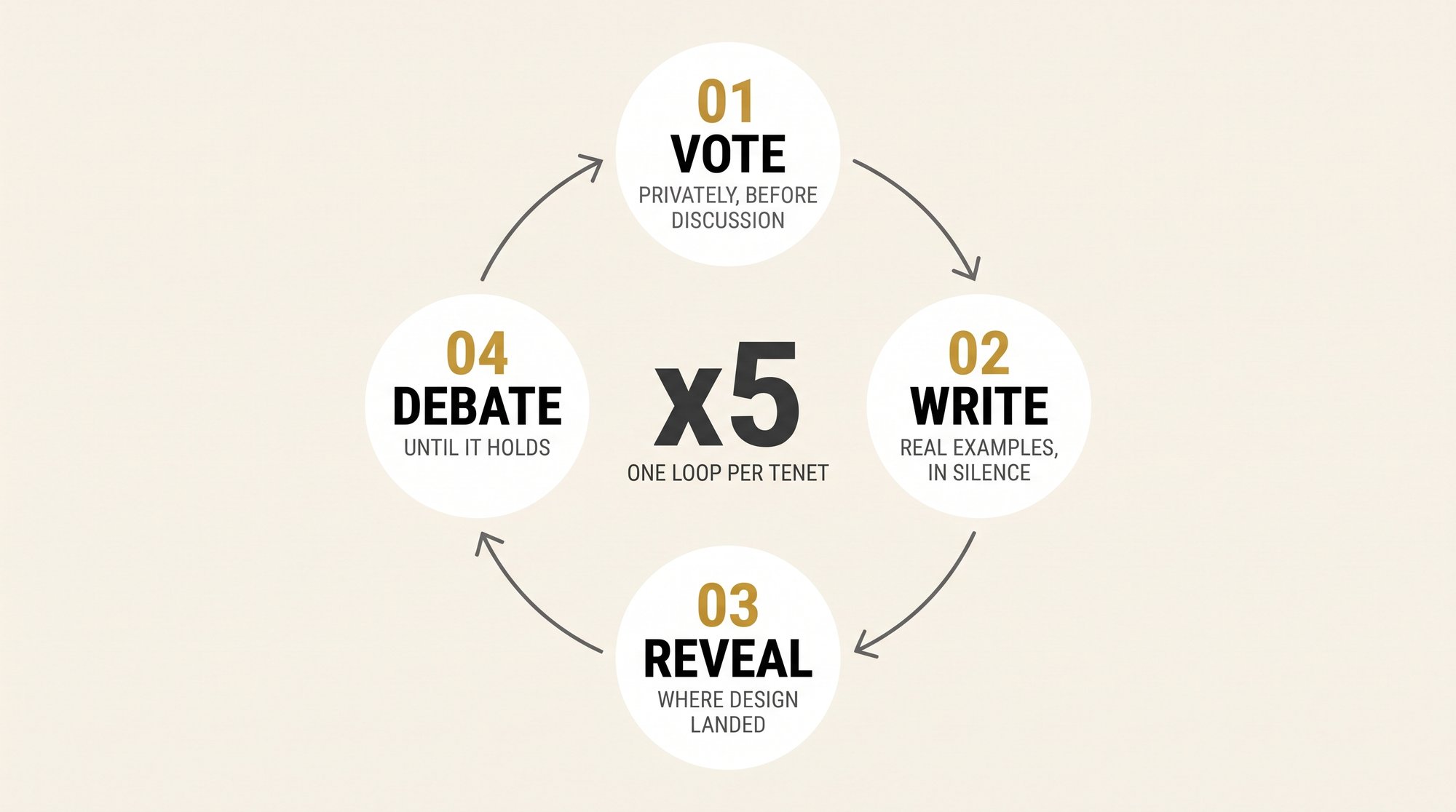
The session ran in four steps for each tenet:
Everyone committed a gut-check vote individually before any discussion, so the most senior voice in the room couldn't set the answer for everyone else.
People wrote real examples silently: "this would've been easier if..." and "I'd have decided differently if...".
We revealed where design had landed.
We debated it until it held.
The cost: I gave up control of the wording, including my own. I went in willing to move everything. If design had missed the mark, that just meant more work to do.
The turning point
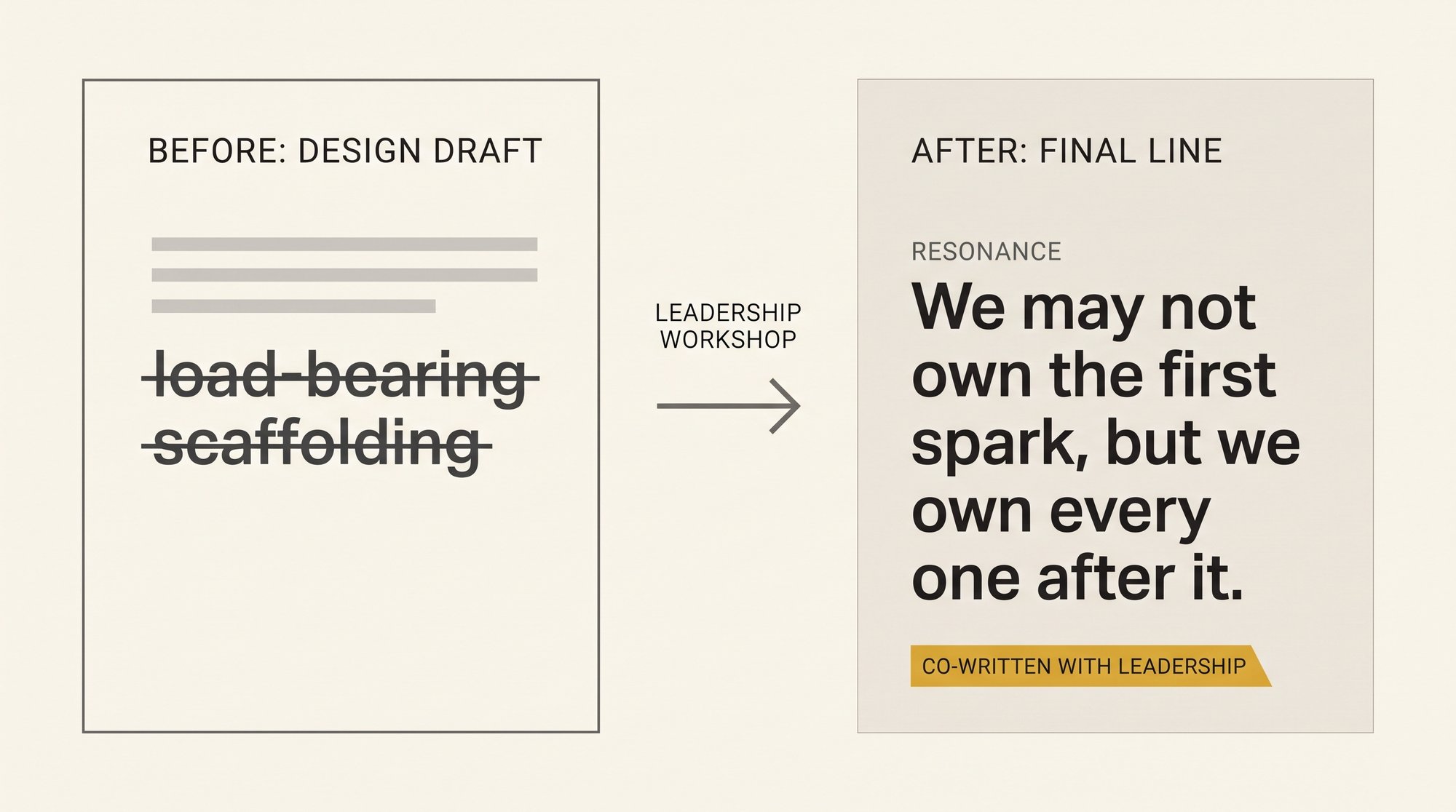
Partway through, leaders flagged my own compression as jargon. Words like "load-bearing" and "scaffolding" made sense to designers and nobody else. I said it out loud in the room: this tenet isn't following the tenet.
Our CPO put her finger on the real requirement. A tenet should never need explaining, because the people who wrote it won't be there when someone reads it. That became the brief for everything after: a tenet has to be readable without its authors in the room.
The direction of the tenets held. Only one, Resonance, needed reworking once leadership added context. The original idea that meaning comes from the user's own effort didn't survive the debate. The CPO's reframe did: it's effort on our part that makes the experience felt for them.
Tenets doing their job
After the workshop, our content design lead wrote the final wording for all five tenets, and every one of them now carries language a product leader contributed. The final lines are short enough to remember:
Clarity: If it needs explaining to be used, it isn't done.
Efficacy: More shipped is not more outcomes delivered.
Velocity: Over-baked and half-baked are the same mistake.
Composability: We own the how. The use is theirs.
Resonance: We may not own the first spark, but we own every one after it.
The tenets are now official and part of our product strategy. The real proof came when we had to cut scope to get the beta of our first agentic product out the door.
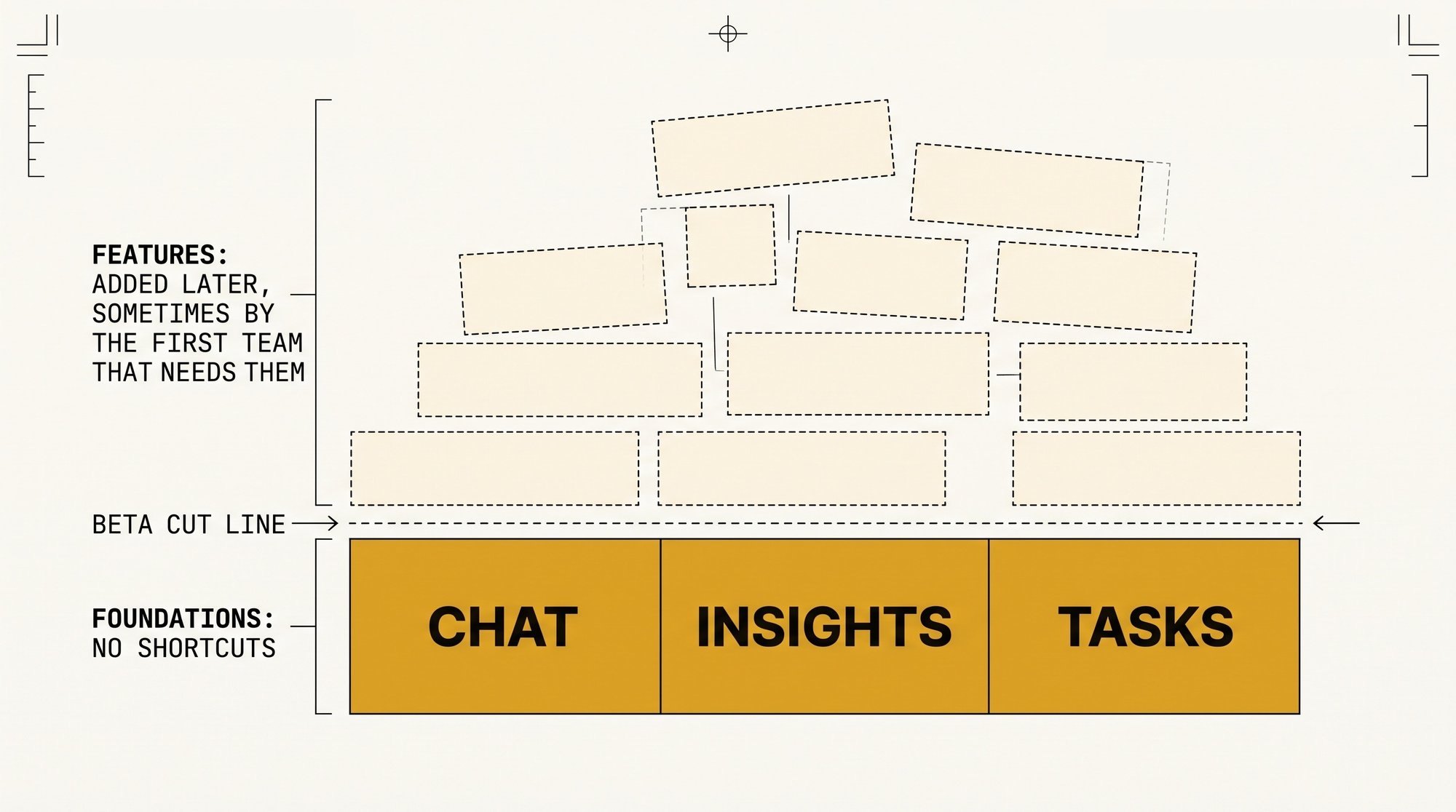
The tenets shaped how we cut. Velocity says rigor should scale with how much gets built on something, how hard it is to undo and what failure costs. So we didn't take shortcuts on the foundations: chat surfaces, insights and tasks are concepts the whole product depends on, and they had to hold strong. Composability says we own the how and the use is theirs. So the features that sit on top of those foundations can come later, sometimes built by the first team that needs them. The tenets also shaped the framework other teams now use to build their own admin experiences in that product, so those experiences stay consistent with each other.
There's an AI side to this too. Because PMs build prototypes with AI tools, the tenets need to reach the tools as well as the people. Two of them, Resonance and Clarity, are being built into our design system's intent layer, so AI tools apply them when they generate interface, not after a designer catches the problem.
Bringing people along
The design and content team found the tensions. The substance is theirs.
Product leadership made the calls, broke the drafts and added the context that reshaped Resonance. Every tenet carries their language.
Our CPO set the plain-language bar that the whole standard is now held to.
Our content design lead, a peer and co-author, wrote the final wording.
I built the framework, designed and ran the workshop, synthesized the output and made the adoption call.
Reflection
This one went largely to plan, and I think the reason is that I went in ready to move everything. Leaders could tell the session was genuine co-creation, not approval theatre, and that's what turned their critique into ownership.
What I can't claim yet is staying power. The checks are still enforced by design, not built into the process, and the tenets haven't reached engineering and marketing yet. That happens with the wider rollout of our UX strategy. The real test of tenets with teeth is whether they hold when design isn't in the room, which is exactly the bar our CPO set.