For most of its life our product had one front door: the web app. It's where people learned how the product works, and every other channel spoked off it.
In 2026 that changed fast. We were shipping Microsoft Teams and Slack integrations, sending more of the experience through email, adding QR codes for in-person giving, opening the platform to third-party AI tools through APIs and MCP, and building an in-product agent. Eight channels, each with a team moving quickly.
Nobody had done anything wrong, but two things had fallen into a blind spot:
Nobody was keeping the model consistent between channels. A term like "cause" versus "nonprofit" is trivial on a web page with context around it. In a chat card with one line of text it breaks.
Nobody was designing for people switching channels mid-journey. Someone might start a donation in Slack, finish it on the web and get the receipt by email. Each piece was designed by a different team, and the journey between them belonged to nobody.
What this means is that as channels multiply, the product starts describing the same thing different ways, and the seams between channels become the places people drop out.
The tension
I kicked this work off, and the hard part wasn't the framework. It was the argument.
Our product requirements documents (PRDs) are the backbone of how we build, and they're good. I help drive their development and I want them to keep getting better. But a PRD describes one initiative at a time, which leaves a blind spot: nothing in it keeps the structure consistent across initiatives and across channels. The cracks show up between documents, not inside any one of them.
My claim was that object-oriented UX (OOUX) fills that gap. An object model describes how our system fits together, and that gives every channel an underlying structure to pull from, so users can build one consistent mental model no matter where they meet the product. The PRD says what we're building. The object model keeps it all hanging together. Everything works better with the two working together.
The hard part was making that case without it sounding like a replacement for the PRD, which it isn't and would have sunk it. I had to point at the cracks and show how the two fit together. Underneath that was a question design answers over and over: what is our seat at the table, and can we prove it's worth having?
And I couldn't slow anyone down. The Teams and Slack work was moving with or without a framework.
The anatomy
The framework has four parts. Each one carries a decision, and each decision cost something.
1. The map: the object model is the hub
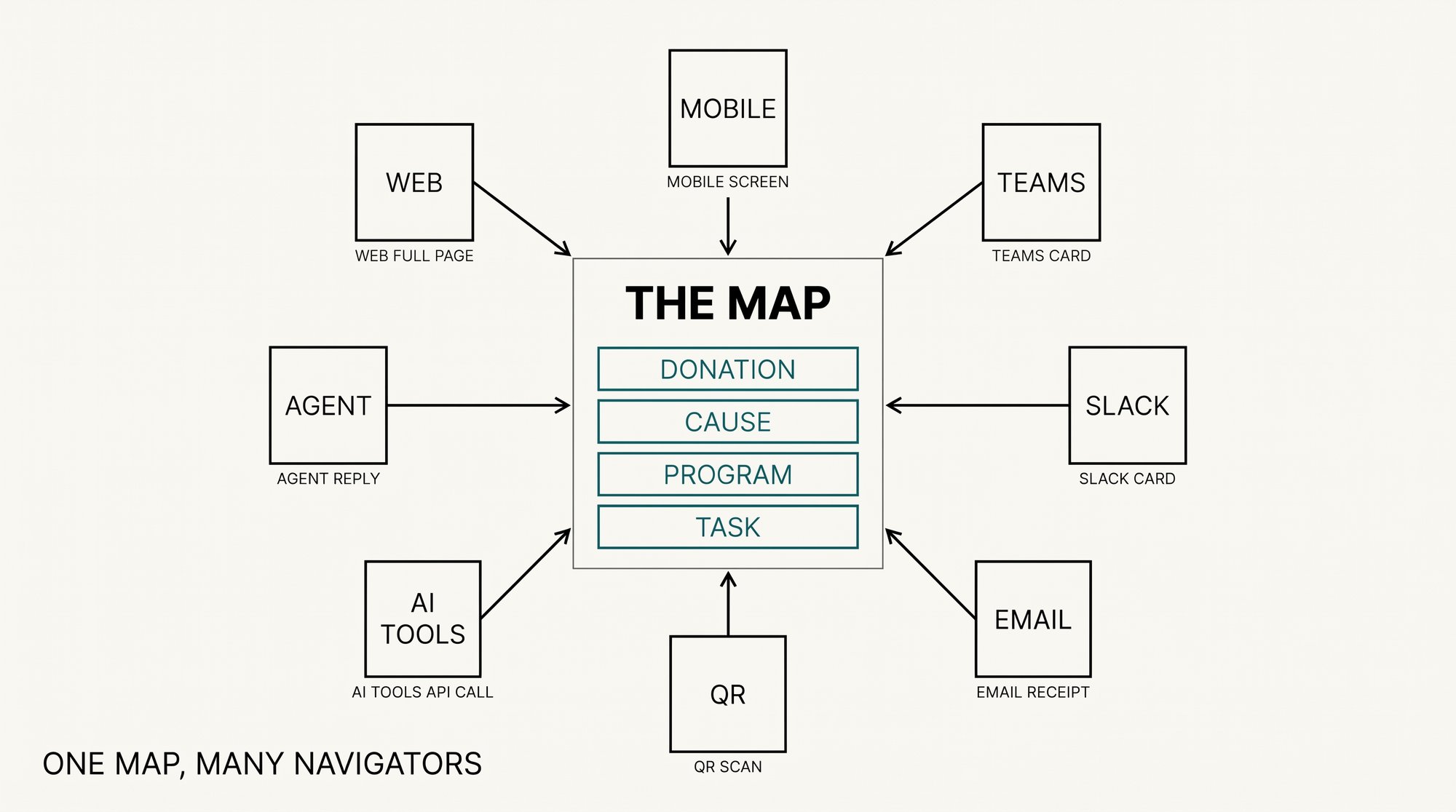
The core idea is One Map, Many Navigators. The domain model is the map: the objects in our product (a donation, a cause, a program, a task), their relationships and their states. Every channel is a navigator reading that same map in its own way. One canonical flow per intent, rendered natively per channel, never reinvented.
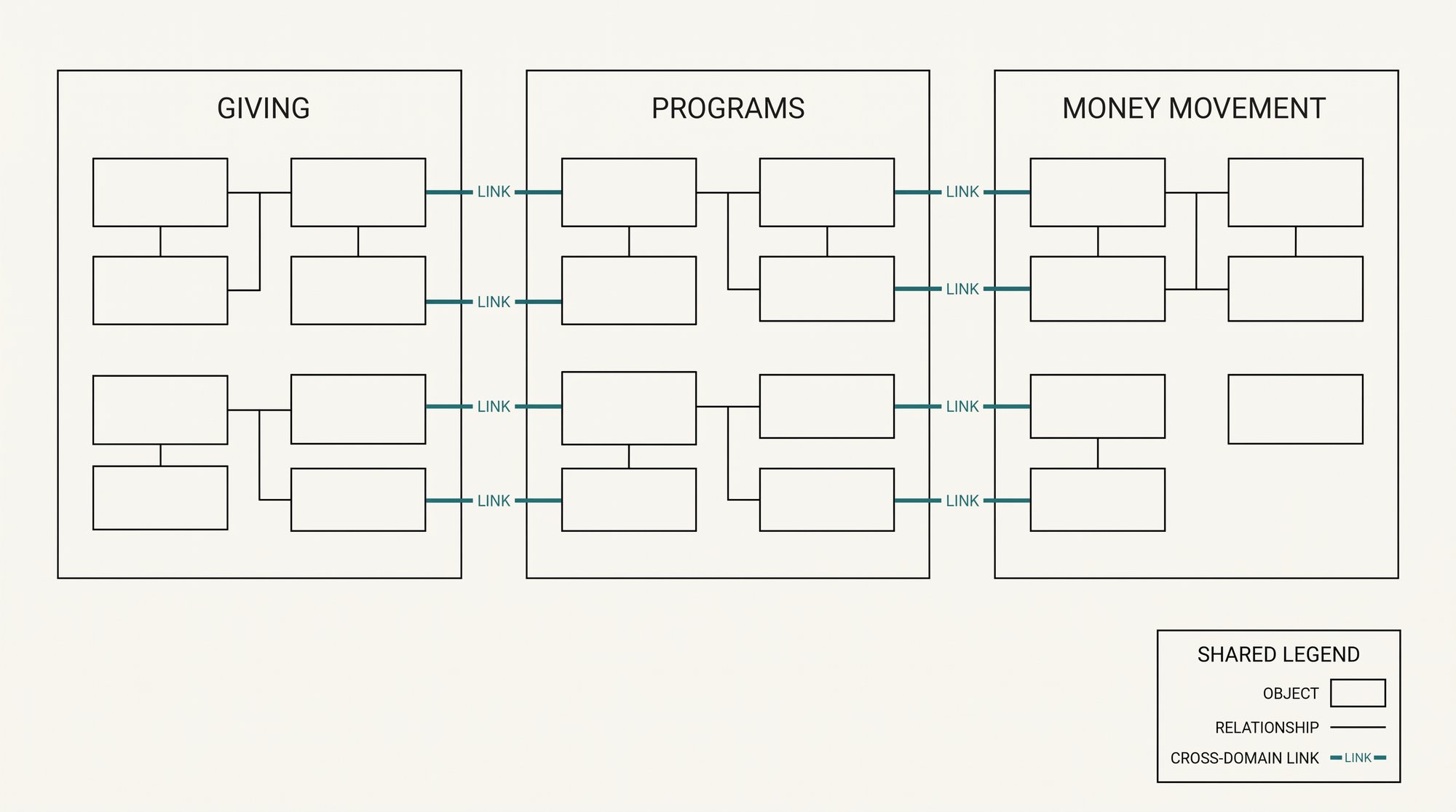
Two refinements made it stronger. The map is really an atlas: each domain owns its model, and the models share a legend and match at the edges. And the hub doesn't have to be a screen. The hub has to be a machine-readable model, not a rendered UI. That matters most for the two navigators that can't see a screen at all: third-party AI tools and our own agent. An agent can only act consistently with the rest of the product if it's reading the same model the rest of the product is built from.
The decision and its cost: the alternative was to keep the web app as the hub and adapt each new channel from it, which is what teams were already doing. Choosing the model meant telling teams that web-first habits don't carry over. As the framework puts it, feature parity is the wrong goal, full stop, web included. A card in Slack is a doorway and a receipt, not a smaller web page.
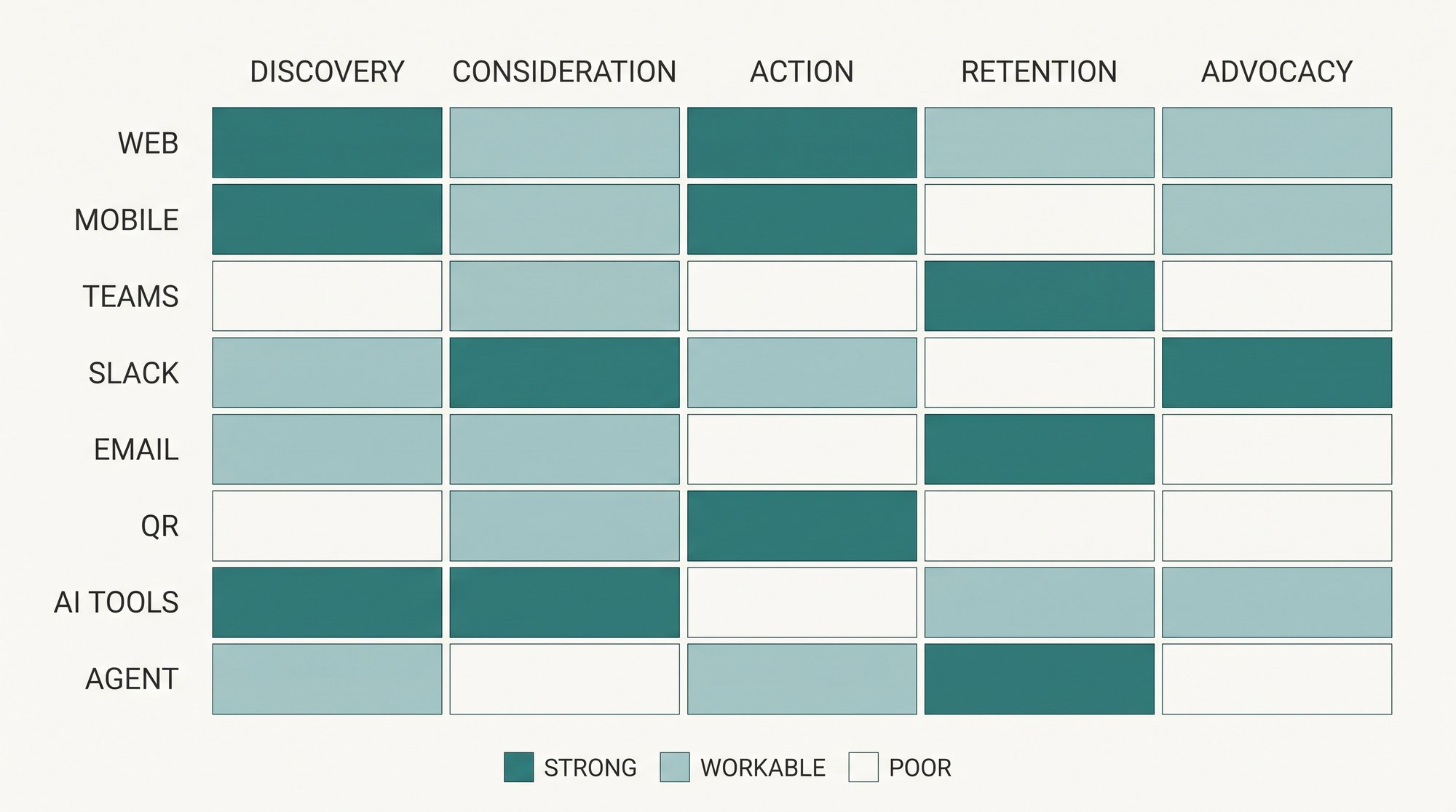
2. The navigators: eight channels, ten axes
Each channel gets a profile: when to reach for it and when not to. Underneath sit ten axes for sizing up any channel, each with a design rule, for example:
A passive channel can never bring anyone back.
Consequential commits climb to the highest-trust channel in the journey.
Every seam is a place people drop out.
The channel definitions and the four tiers of ownership (owned, embedded, invoked, invisible) come from our content design lead's channel strategy. This framework sits underneath hers: her strategy answers why, mine answers how.
3. The journey: five stages and a hinge
The framework maps channels to five journey stages, read as a supply chain rather than a scoreboard: which channel carries the person through each stage, and where the handoffs are. The receipt is the hinge between taking action and coming back, and for our users it's a tax document, not a thank-you note.
Built with other people's expertise: this part of the framework is where it changed most as it went. When we hired a staff designer with an e-commerce background, she brought a five-stage journey model and a new perspective on how people move from interest to action. I worked her model in alongside what I had, and the framework got better for it. That's how the whole thing was built: constant input from VPs, designers and content, folded in as we went rather than saved for a review at the end. When leadership told us they struggle to move from abstract to day-to-day, we added a worked example, a giving-season donation traced across every channel, and made a rule of grounding every idea in something real on the board.
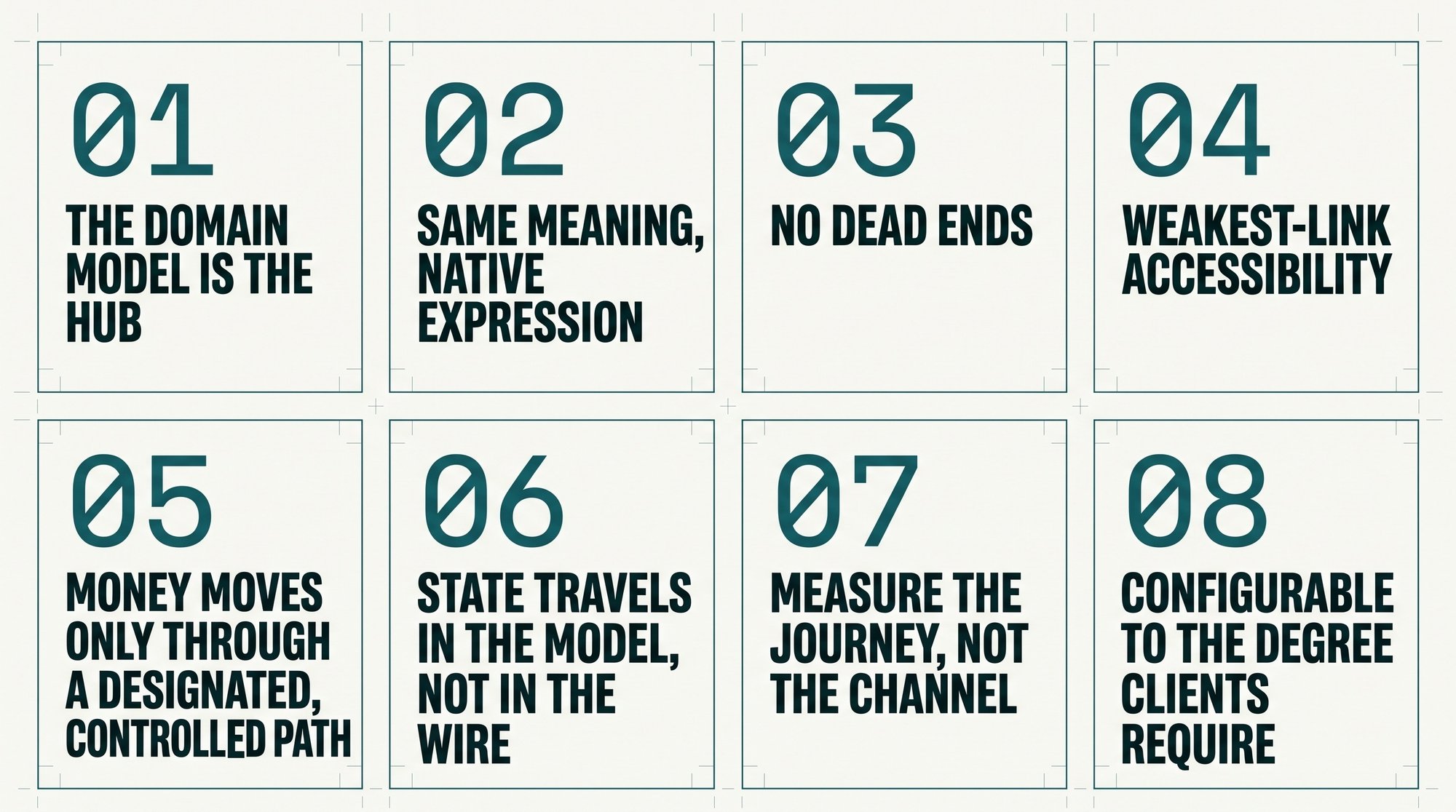
4. The rules: eight non-negotiables
The non-negotiables are the parts of the framework that don't flex by channel, such as same meaning, native expression, no dead ends, money moves only through a designated, controlled path and measure the journey, not the channel. One of them is about accessibility, and it's where the framework is most honest about its limits: WCAG covers web and mobile screens, but a journey that runs through an agent or an embedded panel needs a new approach, which is the work of our accessibility strategy.
The decision and its cost: leadership pushed back on anything that looked like prescribed process. So I repositioned the framework as an instrument, offered on demand, not a mandate, and condensed it from about 40 pages to under 10. The cost is that nothing enforces it. Every team that uses it has to choose to, which is slower than a rule. But a rule nobody believes in gets routed around, and the CPO's direction was clear: show the value without adding process.
Bringing people along
The engagement portfolio was the turning point. A group product manager there ran our OOUX skill on her own to prototype a new market opportunity (that story is in my design strategy case study). Her VP saw the result and the value was self-evident. We didn't need to argue for OOUX, because she'd watched it work. We're now training her team.
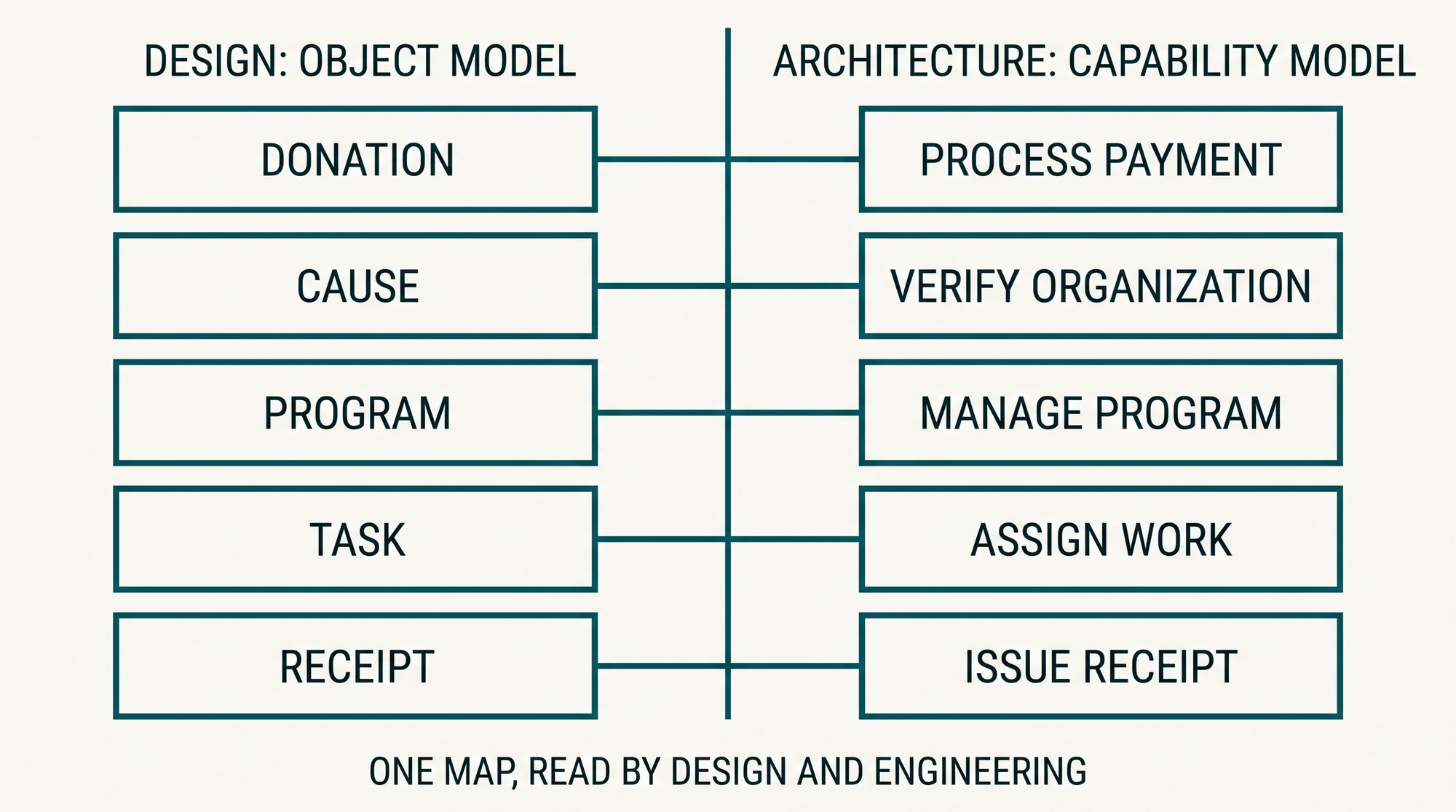
Engineering met us halfway. The engineering leads on our AI-assisted delivery lifecycle came on board with the object-model approach, and our object models are now linked to architecture's capability models. Design and engineering are reading from the same map.
Credit where it's due. The channel definitions and tiers are our content design lead's, the five-stage journey came from a staff designer, and the OOUX skill behind the engagement story was written by another staff designer on my team.
Still earning it. Most product VPs are on board. The CPO's direction is to see the value realized without adding process, which is exactly the bar the framework has to clear.
What changed
The framework is under review with product leadership, and OOUX is step one of the rollout, because object models are the center of the whole thing. A lot of it is already in use:
Object models are established for our main product areas, linked to architecture's capability models.
The object model works alongside the PRD. It's a standard input to our AI-assisted delivery lifecycle, and we're working out how OOUX feeds the PRD-writing skill directly.
OOUX runs on all new work in three portfolios: AI, engagement and money movement. AI was the least surprising. Engagement was the big win.
The engagement team is being trained in OOUX after its VP saw a group PM's prototypes.
Conversation Mapping, the next tool, is being built into our design-thinking skills. It's an AI-first take on journey mapping: instead of fixing a path through screens, it maps the user's intent and the signals around it, so the experience can be constructed around what the person is trying to do.
The Teams and Slack integrations are in beta, designed from the same model as the web app.
Reflection
The lesson here is the same one I took from our design strategy: you have to work while the work moves.
I put a lot of effort into getting the document right, and the Teams and Slack integrations didn't wait for it (they shouldn't have). The alignment that actually mattered happened beside the teams: a group PM running a skill on her own, engineering leads linking models, a VP watching a prototype come together.
If I did it again, I'd go to the teams first, get alignment on the model while the work was happening, and let the official documentation follow. The document is still useful. It just isn't where the buy-in comes from.