Operationalizing Agentic AI
Benevity
From "Random Acts of AI" to a Strategic Operational Roadmap
Challenges
Our organization faced an aggressive mandate to accelerate the Product Development Lifecycle (PDLC) Software Development Lifecycle (SDLC) using AI. However, without a unified strategy, adoption was fragmented.
Siloed Experimentation
Individuals were "vibe-coding" or generating designs in isolation. While innovative, this bypassed our Design System and Accessibility standards, creating significant quality debt.
The Feeder Problem
Accelerating engineering was moot if the upstream Product Development pipeline (Discovery, Strategy, Requirements) remained slow and manual. We needed to feed the engineering machine faster.
Strategic Stasis
Leadership discussions were circular, driven by personal opinions on new tools rather than a clear understanding of where AI could solve actual process bottlenecks.
Team
Core Team Members
Manager, Product Design (Me)
VP of Product
Director, Technical Program Management
Participants and Stakeholders
Chief Technical Officer
VP of Engineering
Product Operations
DevOps
Manager, Product and Application Security
The Product AI Maturity Blueprint
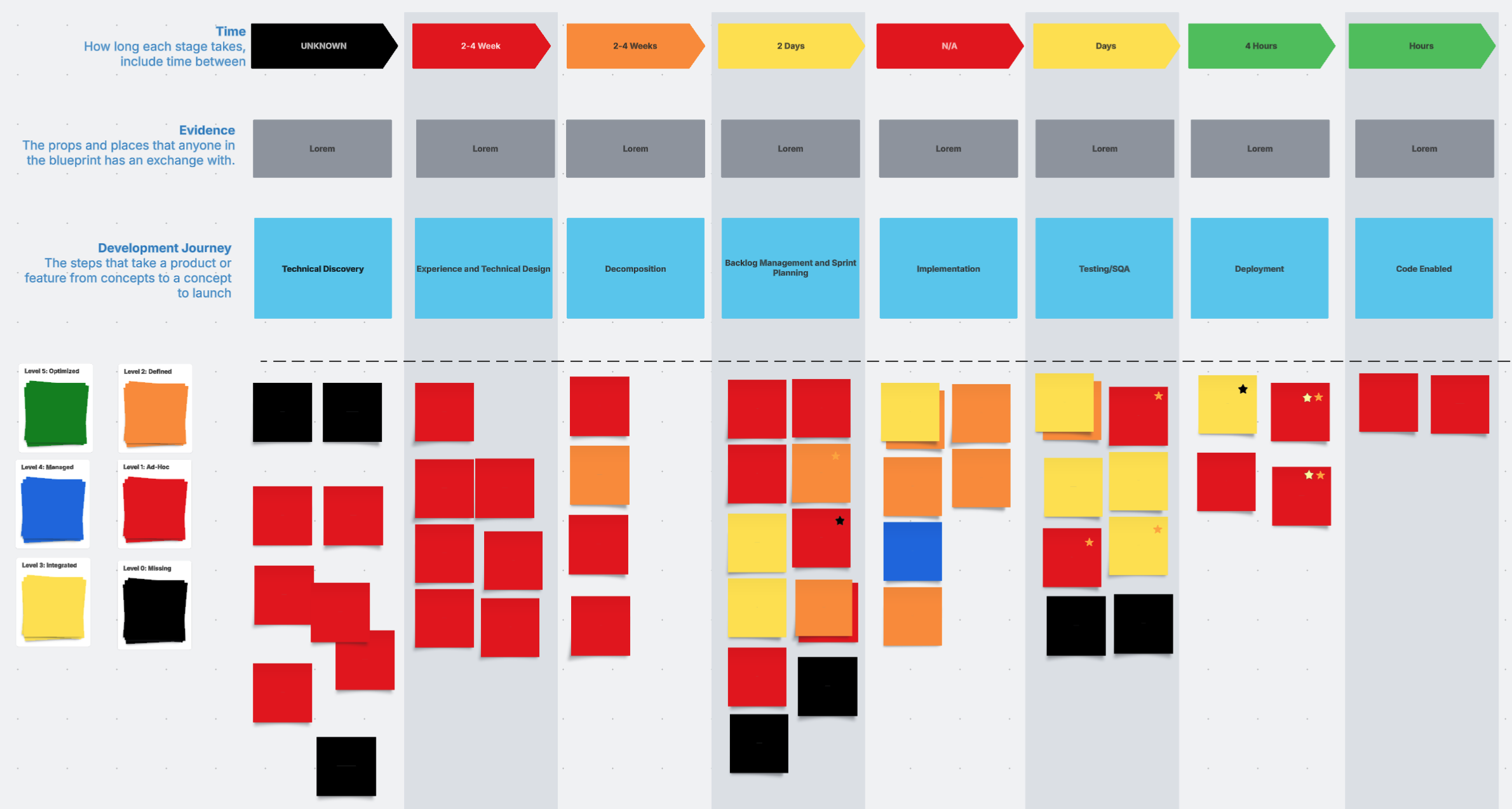
I developed a custom framework adapting Service Blueprints, typically used for user journeys, to map our internal operational maturity. The goal was to visualize the entire lifecycle and identify a path to Agentic AI.
The Framework Mechanics
I established a maturity scale to grade every action and asset in our pipeline:
Manual
High-touch, creative, or risk-sensitive tasks.
Standardized
Teams using AI point solutions for specific tasks.
Agentic
Fully autonomous workflows where "agents" execute complex chains of tasks
The Workshops
I facilitated multiple strategy sessions with product and technical leadership to map two distinct flows:
The Product Development Lifecycle (PDLC): From Ideation and Strategy to Solution Design and Launch.
The Software Development Lifecycle (SDLC): Focusing on the engineering handoff, coding, and deployment.
We cataloged every prop and exchange—from Requirement docs and Jira Tickets to User Story Creation and Code Repositories
Key Insights
Uncovering Process Debt
The visualization was unforgiving. It exposed areas where we couldn't apply AI because the underlying human process was undefined or broken. This shifted the conversation from "Which AI tool do we buy?" to "How do we fix our core operations?"
The Stitching Opportunity
The blueprint revealed that our biggest opportunities weren't in automating single tasks, but in "stitching" clusters of tasks together.
Example: We identified that Research Source Aggregation, Competitive Analysis, and Support Ticket Reviews were treated as isolated efforts. By stitching these into an Agentic workflow, we could synthesize all existing knowledge to auto-generate a targeted Research Script. This ensured we stopped asking clients the same questions repeatedly and focused our research plans entirely on uncovering net-new insights.
Designing for Governance (Human-in-the-Loop)
The map highlighted critical areas where we explicitly decided not to automate.
This solved the "vibe-coding" issue: Agentic workflows were designed with our Design System and Accessibility rules as architectural constraints, not afterthoughts
A Prioritized Path Forward
This initiative successfully moved the organization from reactive experimentation to proactive architectural planning.
Operational Roadmap: We delivered a prioritized backlog of "Agents" to build, focusing on high-friction areas like Regression Testing and Documentation Aggregation.
Cross-Functional Alignment: The blueprint served as a "boundary object," forcing Engineering and Product to agree on a single version of the truth regarding hand-offs and timing.
Systems-Level Impact: Elevated the design discipline from execution to strategy, applying service design principles to "design the machine" and ensure our internal processes are as robust as our external products.