Our admin experience is where the people who run giving and volunteering programs at large companies do their work. It had been built over many years by many different teams. Each team added what its own users needed, and each addition made sense on its own.
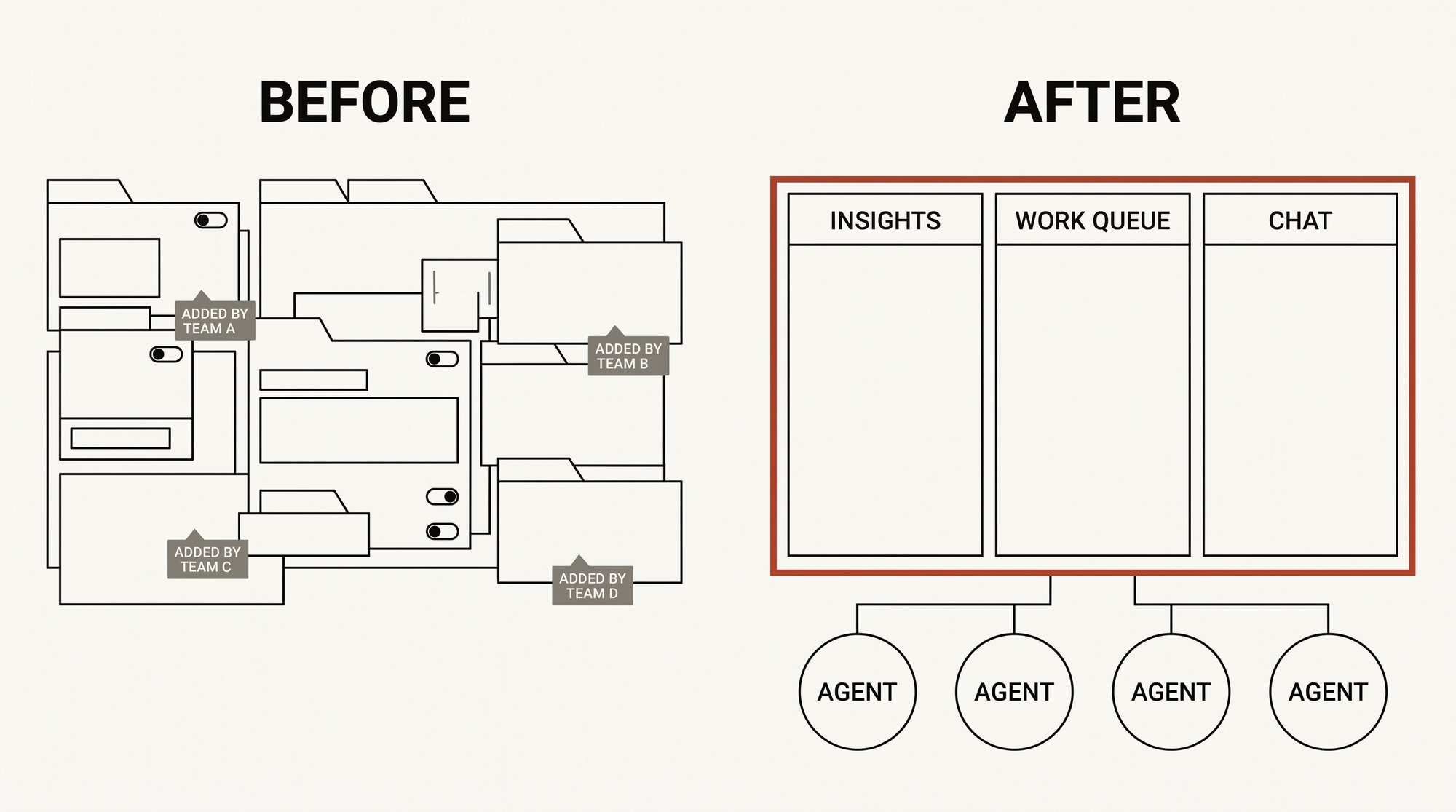
Together, they made a Frankenstein product. Disjointed sections were bolted on to fit each team's needs, settings and toggles piled up, and nothing held a central vision of what an admin is actually trying to get done.
Our research showed what that cost the people using it. Admins lost the most time to three things: generating reports, tasks that forced them to rely on our support team, and simply finding information. Reporting was both the most frequent problem and the most severe, and it was tied to whether clients renewed.
When the company decided to build its first AI-native product, this was the obvious place to start. It was also the riskiest place to get wrong. An agentic product built the same way, with each team adding its own agent, would just be a faster Frankenstein.
The shift
Start with the jobs, not the screens
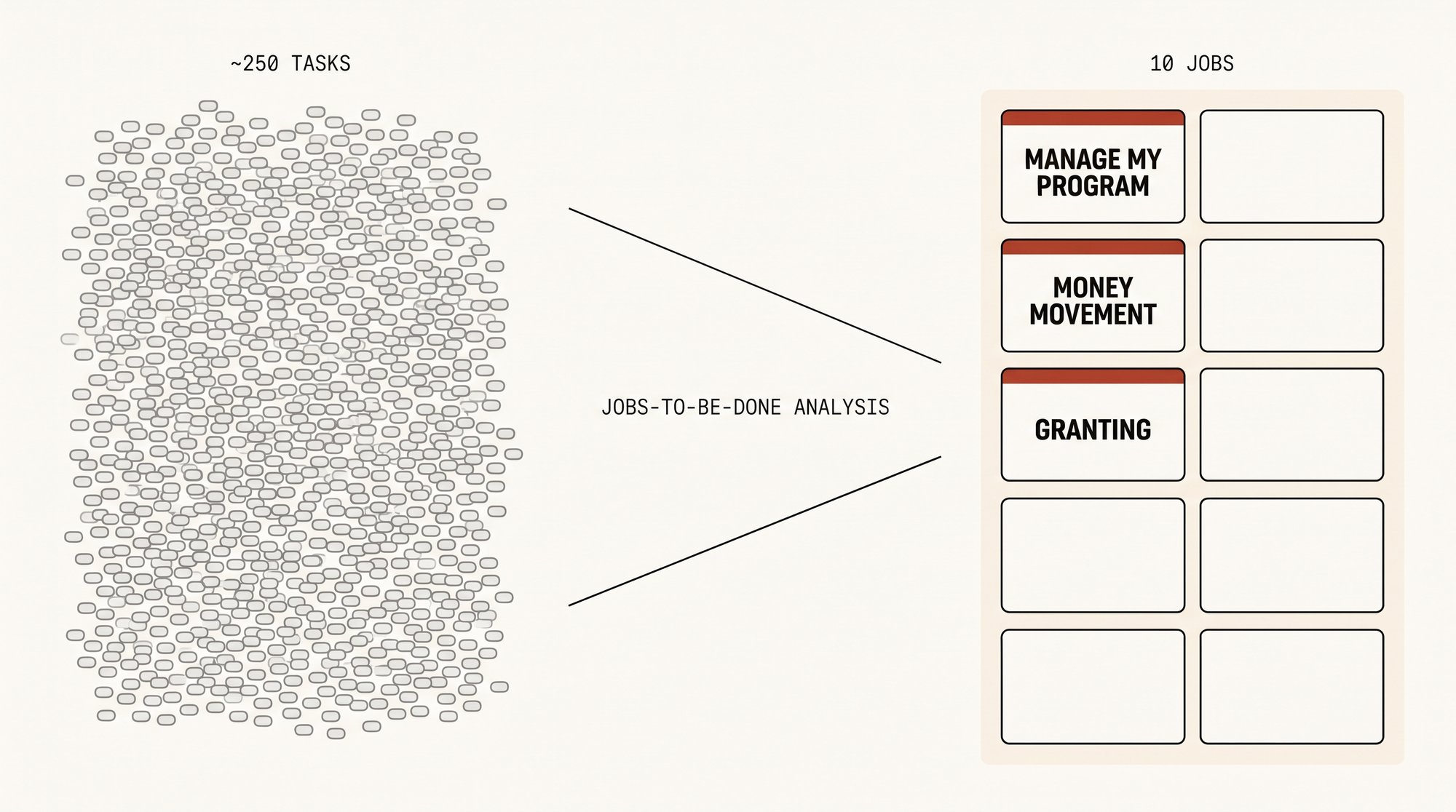
We had a document listing about 250 admin tasks. Automating that list would have meant automating the mess we already had. So I ran a jobs-to-be-done analysis to find the jobs underneath the tasks, and the 250 tasks collapsed into 10 real jobs, things like "Manage my program", "Money movement" and "Granting".
Those 10 jobs became the design framework for the whole product. An agent, a page or a feature has to serve one of them, or it doesn't belong.
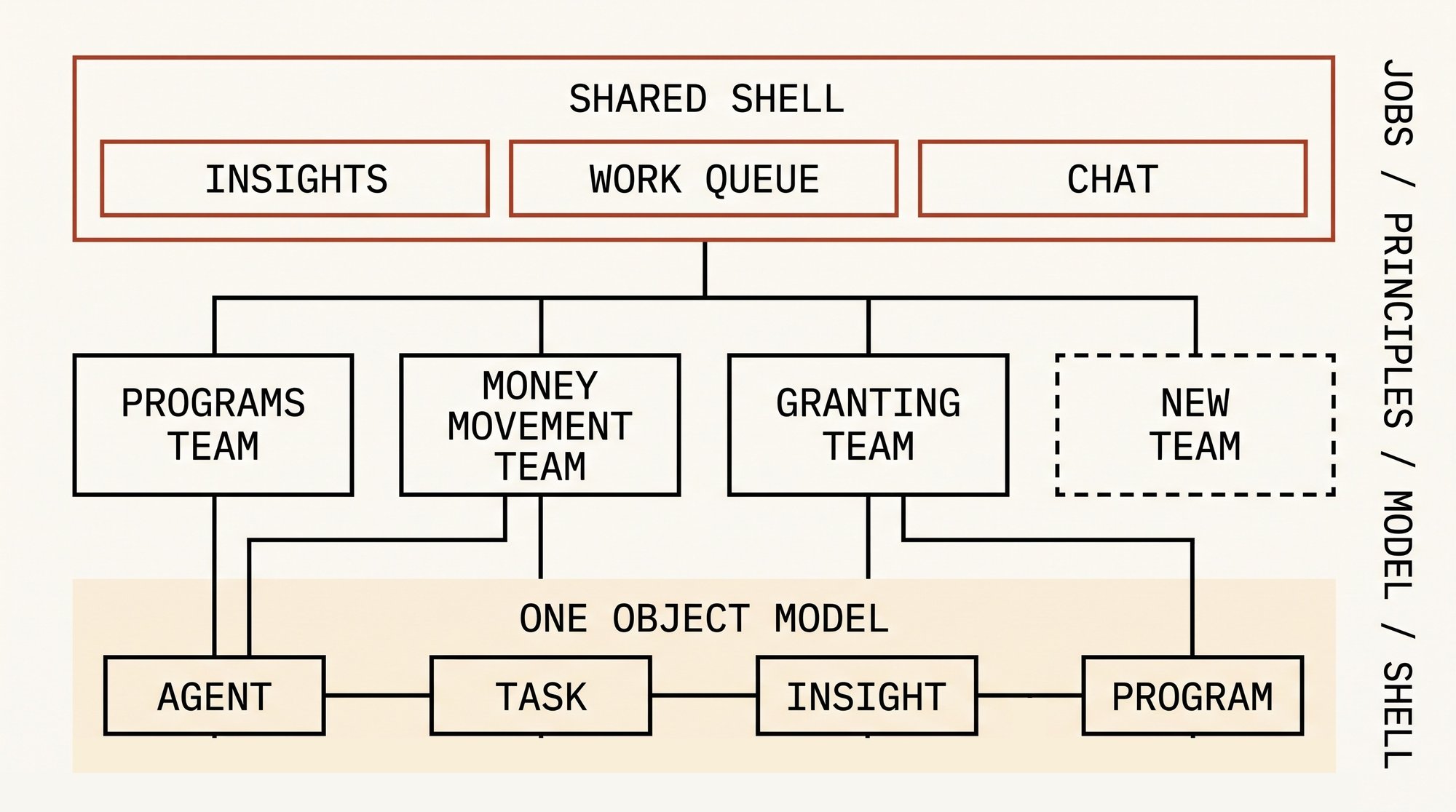
Our staff designer was in from the ground floor. She ran an object modelling session from client interviews that gave us the domain model the product is built on: what an agent is, what a task is, what an insight is, and how they relate. That model is now a required input for teams building in our AI delivery lifecycle.
Principles for agents people can trust
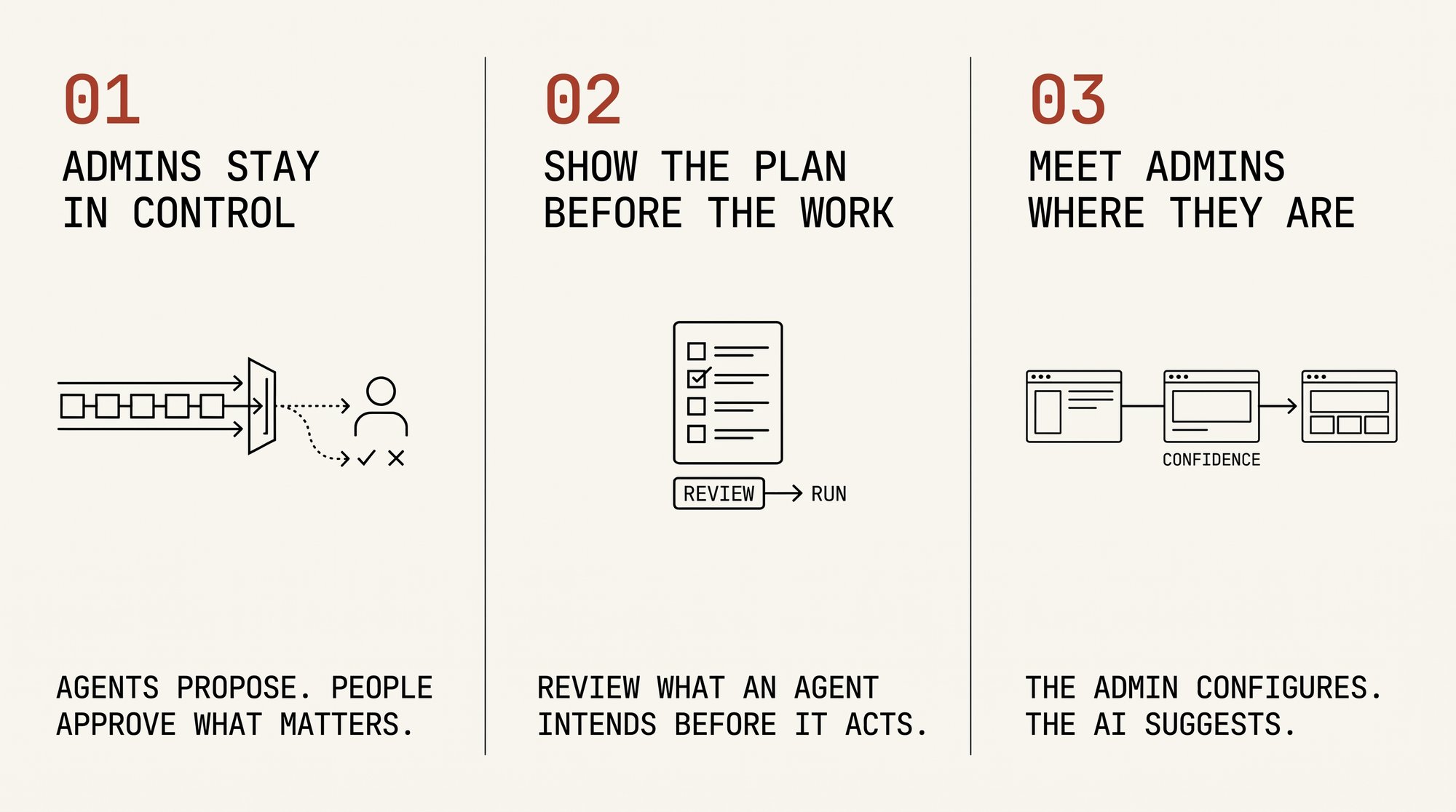
Agents change the relationship between a person and their software. The product doesn't just wait to be used anymore. It acts. So before designing screens, the staff designer ran an empathy mapping session, and the two of us built our agent principles from what it surfaced:
Admins stay in control. Agents propose, and people approve anything that matters. Our first agent screens requests against rules the admin has approved, handles the clear cases and brings edge cases to a person one at a time.
Show the plan before the work. Admins can review what an agent intends to do before it does it.
Meet admins where they are. The homepage starts by teaching, and shifts toward recent work and insights as an admin gains confidence. The admin configures, and the AI suggests.
Small rules mattered too. Our product shows several figures in dollars, and two dollar amounts side by side invite people to connect them even when they measure different things. I made it a design rule that same-unit figures must always be clearly distinguished. A framing preference became a requirement, and a whole category of misreading went away.
Decision: a shared shell, with agents owned by the teams who know the domain
The product is a shared shell (an insights feed, a work queue and embedded chat) sitting over agents that domain teams build and own. The teams that know money movement build the money movement agents. The teams that know granting build the granting ones.
That's the right call for expertise, and it's also exactly how the old admin became a Frankenstein. So my main job became the framework other teams use to build agentic admin experiences that stay consistent with each other: the jobs, the object model, the principles and the shell they all plug into.
The cost: consistency across many teams is never finished. We're still shaping the shell as we learn from building it, and every new team is a test of whether the framework holds.
After
Decision: agent first, pricing second
Early on, we tried to make the agents fit a pricing model. It added complexity everywhere, because the structure of the product was being bent around how it would be sold.
The fix came from one of our product managers. Design the agents around what users need first, and fit pricing to that model afterwards. It cleared things up immediately. That's the value of object modelling: once the model is on the table, anyone on the team can see the better answer, not just designers.
The cost: pricing questions stay open longer. We'd rather have a clean model and an open pricing question than a tangled model and a tidy price list.
When we had to cut scope to get the beta out, the same thinking held. We protected the foundations (chat, insights and tasks) and let features come later. That story is in my design tenets case study.
Bringing people along
Our staff designer led the design. She ran the empathy mapping and object modelling, and took the work from my early low-fidelity prototype to high-fidelity, build-ready designs.
I set the direction. I ran the jobs analysis, built the first prototype to get leadership sign-off, led the framework conversations on how to design agents users can understand, and coached the team through it.
A product manager found the agent-first answer that untangled pricing.
Our Chief AI Officer sponsored the product from the start and kept the pace high.
What changed
The product is in beta with clients, built around the 10 jobs.
It debuted on the main stage at our annual client conference, where the demo went over well.
Other teams are building on the framework, so their admin experiences become AI-native instead of ports of the old, toggle-heavy ones.
The object model is a required input for teams building in our AI delivery lifecycle.
Reflection
This went well because design was in on the ground floor. We shaped the jobs, the model and the principles before anyone drew a screen, so the screens had something to stand on.
The proof for me is how our Chief AI Officer responded. The product was moving fast, and any design process that didn't immediately prove its worth was at risk of being seen as a roadblock. He saw the value of object modelling and design-thinking exercises right away, and he never treated them as one. When design shows up early with the right tools, it makes a fast team faster.